DIY Eurorack: Low Frequency Oscilator
“What’s the point of modular synthesis if you’re not modulating something?”
I heard something along those lines when first getting into modular and it stuck with me. I knew after making the basic setup of a VCA + VCA + VCF, I’d need a module to act as a modulation source that could plug into a few of the CV inputs on my previous modules.
Enter the Low Frequency Oscilator. As with other module types, there are tons of designs and approaches for LFOs. I was tempted to go big with a multi-LFO output with CV inputs for every control (which would allow modulating the modulators), but I decided to keep it simple for my first LFO build.
Step 1: Schematic
I found Benjie’s MiniLFO which itself is based on David Haillant’s Simple LFO. The design uses a TL074 as a Schmitt Trigger which creates a square wave, and then uses a separate op-amp to convert that square wave into a triangle wave.
I combined ideas from both schematics, although my final design was closer to Halliant’s because I wanted a switch to toggle between square and triangle outputs. I added a voltage divider on the triangle to keep the output level closer to the square’s level.
I also didn’t have a non-polar LED on hand, so I opted for a single LED with a 1N4148 diode in anit-parallel. This LED will only light up during one-half of the cycle, which is fine with me as it still provides some indication of the LFO rate.
Step 2: Stripboard Layout
Nothing special here, aside from re-using a trick from my VCO build, where I cut out a section of the stripboard to make way for the switches. Luckily I didn’t need to connect power from the back board to the front, but I still had quite a few wires to connect which is the most annoying part of this build style. Oh well.
Step 3: Assembly
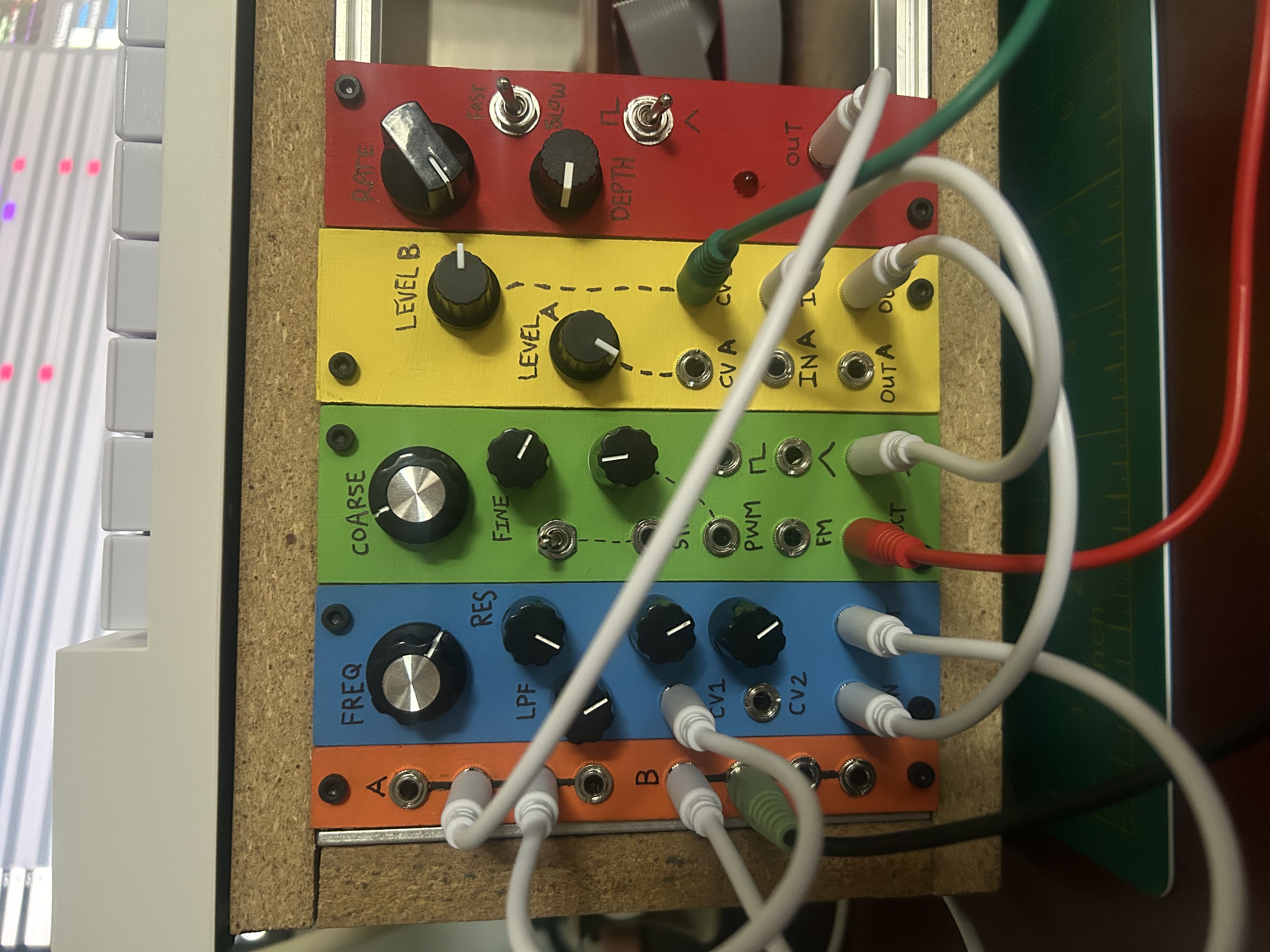
Assembly went smoothly. Grabbed some red paint from the kids’ arts and crafts box, used my best handwriting (which is terrible) to label the panel and I was done!
Here’s the full setup so far (LFO in red):
Demo
Quick demo of the LFO:
Specs
Size and Power Consumption
| Attribute | Value |
|---|---|
| HP | 7-ish |
| +12V | 4 mA |
| +5V | 0 mA |
| -12V | 4 mA |
Price
Op-amp (\$0.5), knobs and pots (\$1), switches and jacks (\$1), panel (free!), other stuff = about \$4.
Read about how I’m making my panels at the bottom of this post.
Project Files
Checkout the schematic, stripboard layout, and other files here